
Breaking mindset limitations to run faster and farther
Kay Bretz (pronounced “Kai”) is my podcast guest this week. He has a long list of accomplishments in business and in running. His running accomplishments are impressive.
Member of Australian 24-hour national team Australian Ultra Performance of the Year Award 2019 and Bryan Smith Award 2019
Fastest-ever Australian at 24-hour world championships (Albi, France 2019), covering 259.67km
Holistic approach to transform from hobby runner to one of best ultrarunners worldwide (11th male at world champs), balancing spiritual, mental and physical preparation.
- Winner of 12-hour race at Princes Park 2021 (137.6km)
- Winner of Last One Standing Brimbank 2021 (36 hours, covering 241.4km)
- Second place at 350km trail race through Western Australia (Delirious WEST 2019, 68:52 hours)
- Third place at Australian trail championships (Two Bays 56km 2018, 4:36:55 hours)
- Second place at Christchurch 100km 2016, New Zealand championships (8:19:59 hours)
- Winner of Big Red Run 2015, a 250km stage-race over six days through the Australian Simpson Desert (improved course-record by 5:21 hours)
What he is really excited about is helping high performing people become elites.
Trail running is his way of seeing something new and seeing what emerges, and that has driven him all his life.
Kay was born and raised in Germany and then was in boarding school in Scotland. He’s lived in Japan and Russia, now living in Melbourne, Australia.

First 1K race at age 7
First long distance run at age 7. It was one kilometer. He didn’t run the race like a typical 7-year-old. Most children run fast until they are tired, then walk, then run again. He held back at the start because he was afraid of not making it to the finish line. He let everyone pass him and told himself he would sprint at the end to catch them. He didn’t win the race, but he passed a lot of people at the end.
Thinking things through came natural to Kay. He knew that what he might lack in natural talent he could make up with discipline and hard work.
The emerging theme for his life was keeping control and being smart and logical. That got him a measure of success, but he hit a limit that felt like he couldn’t get past.
He ran his first marathon at age 19 with a time of 4 hours 15 minutes. He used his skill at planning and hard work to run faster by the time he was in his mid-30s to 2:44:00.
But it didn’t improve any more, no matter what he did. His method of keeping things under control and using discipline got him that far, but also held him back from getting to the next level. He had detailed training plans: long runs, intervals, tempo runs.
Mindset training got him to the next level
He was focusing all on the physical part of training. But he didn’t spend any time on the mental part of running. How to regulate emotions, how to deal with setbacks. He wasn’t good at dealing with curve-balls and the unexpected.
Doing the physical work of running is easier than facing our thoughts and emotions. We don’t ask ourselves, “To what extent I’m I the problem of the challenge I’m facing?”
Kay found a mentor who saw his limitations. He said, “Kay, you are good at reaching goals because you are always realistic. But you are limited because you never go beyond what is realistic.”
This advice didn’t resonate with Kai, because it didn’t give him any action to take. He was working hard to improve his marathon time. And he was working harder and harder, but only improved 9 seconds for his PR.
What his mentor helped him do was see his limitations and experience them for himself.
He told Kay to do “Mystery Runs.” This is a term his mentor just made up.
He told Kay to get a friend to run with him and conduct the Mystery Run session. The friend set the pace, the distance, the route, and the length of the run and wasn’t to tell Kay anything before or during the run. Kay just had to follow and keep up with his friend. This took away all the control from Kay.

Turning right: Where it all started
Kay asked his friend, Cory, to lead his Mystery Run. They left the house, and when they went through the garden gate, and Cory turned right. Kay realized that never before had he ever tuned right at his garden gate. He always turned left. He was doing the same thing over and over again, expecting different results. He instantly knew what his mentor was talking about. Because there was a world outside his house that he’d never entered.
Then his intellect kicked in and said, “What does it matter? Turning right or turning left can’t be that important.” That’s what happens to many of us. We get this kind of revelation then argue it away.
Kay started to think that maybe he was a bit too controlled, but he couldn’t see the benefit.
Next, Cory took Kay on a trail run, and started sprinting up a big hill. Cory was a stronger runner, and Kay thought he didn’t have a chance to catch him, but he did. And that was another “right turn.” It’s not the smart thing to do to chase someone you probably can’t catch. But sometimes you can win.
From marathons to ultramarathons
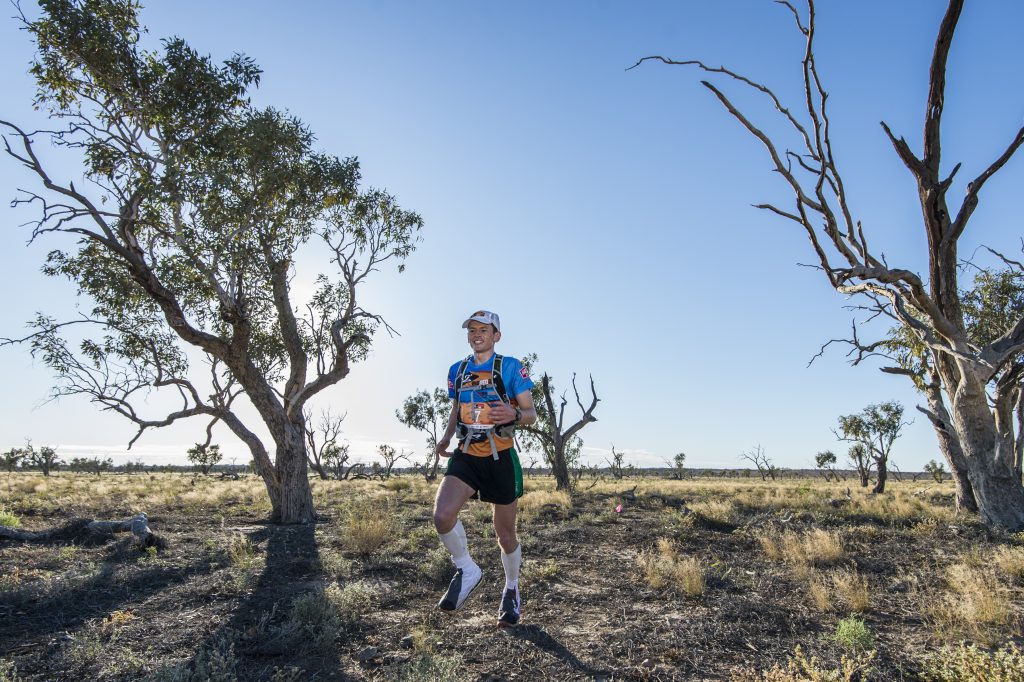
That made Kay start looking for more ways he could push his limits and see where it leads to. He wanted to find out what was possible for him. So he went from running only marathons to running a 150 mile, 6 day stage race in the Australian outback. It was a long way outside his comfort zone.
In the past, he trusted his intellect. But he realized that the future he was seeing in his mind was sometimes wrong. He began to ask himself, “What else can I do?”
He began to train both his body and his mind for this race. His plan was to prepare for anything he could foresee. And at the same time, be open to deal with the unexpected and know that it will happen.
His first challenge was the trail marking. The path was marked with small pink flags, and he was worried he could easily miss one and get off course. But he re-oriented his thinking and told himself that he would get used to them.
The first day he just ran, without worrying about pace. It was a marathon distance, and in deep sand. He knew he was in the lead, but then came on footprints in the sand. He saw someone up ahead, and pushed hard to catch them. He discovered it was the man marking the trail with little pink flags. When he arrived at the overnight camp, they hadn’t even set up the finish line because he was 45 minutes faster than anyone had ever run the first section.
He faced a lot of doubts because all the experienced runners expected him to burn out the second day. But he ran an even faster time on the second day. Then he felt the pressure of expectations to keep setting records. He had to put that aside and focus on just running.
He worried about the day of the longest run which was 50 miles. He got through it. But it was more of a struggle.
A mindset toolkit for ultramarathon running
He developed a mental tool kit to help him improve his performance. Thinking less. Being present. Not predicting himself into the future.
He uses meditation practice apart from running and in his running. It helps him create a space in challenging situations to make the choice to go a different direction. It gives time to step back and tell a different story.
He used this in a race when his quads were cramping. Instead of telling himself the story that he couldn’t go on, he accepted the situation and said, it may not last. Let’s just keep going.
Mental calmness doesn’t force pain to go away. It’s more that when you don’t worry about it staying or going, it tends to go away. When you try to control the pain and push it away, that doesn’t work.
The body is following wherever the mind allows it to go. Be present, and create the possibility for that magic to occur, and the sky’s the limit.
You can push your body, like driving it with a whip, but that only works as a short-term strategy. Sprinting, for example.
We don’t control our pain or our emotions. The best long-term strategy is tuning in. Zoning out, or ignoring discomfort may work in the short term.
The problem is not the pain itself. The problem is the story of disaster we spin around the sensation of pain or discomfort. If we project that story of disaster into the future it saps our energy and makes us think it’s impossible to go on.
This was the key to Kay’s breakthrough. He reached a limit when he tried to control the outcomes. But when he let go and accepted what was happening, he was able to break past his previous limits.
Through running, he has realized that anything is possible. He started asking how he could help others get there as well. He now does executive coaching for high performers get to the next level by “turning right” and learning how to deal with the curve-balls of life.
He wrote about his process in his book Turning Right. His goal is to help the reader go on their own journey of transformation.
Anyone is capable of running 100 miles. Yes, there are physical challenges, but it’s more about the mental strength and the belief that it’s possible. Whether we believe we can or believe we can’t, we are right.
Connect with Kay:
Facebook: https://www.facebook.com/kaybretzturningright
Instagram: https://www.instagram.com/kaybretzturningright/
LinkedIn: https://www.linkedin.com/in/kay-bretz/
Kay’s book on Amazon: Turning Right
Leave a Reply