Speaker notes
Do you feel like you’re lying when you say your affirmations out loud?
Do you say things like, “I am an awesome, successful winner?” And hear a little voice say, “No, you’re not!”
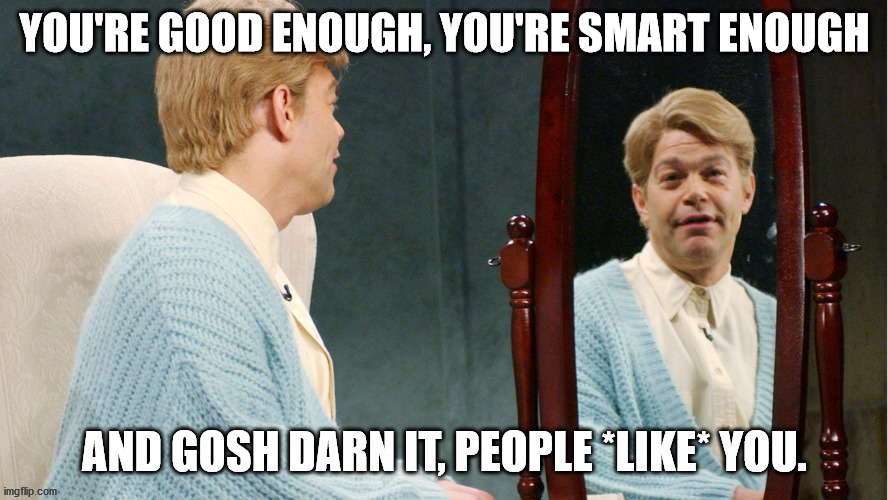
Stewart Smalley: I’m good enough. I’m smart enough. And gosh darn it, people like me.
Affirmations seem like a good thing, because most of what you tell yourself is negative. And you have years of negative self-talk stored up in your brain. So when you say your affirmations, it feels like a lie.
Do affirmations work?
Several studies have shown evidence that they do.
- Self-affirmations have been shown to decrease stress (Sherman et al., 2009; Critcher & Dunning, 2015);
- Self-affirmations have been used effectively in interventions that led people to start exercising (Cooke et al., 2014);
- They may help us to perceive otherwise “threatening” messages with less resistance, including interventions (Logel & Cohen, 2012);
- They can make us less likely to dismiss harmful health messages, responding instead with the intention to change for the better and to eat more fruit and vegetables (Epton & Harris, 2008);
- They have been linked to positive academic achievement by helping college students turn around a falling GPA (Layous et al., 2017);
- Self-affirmation has been demonstrated to lower stress and worry (Koole et al., 1999; Wiesenfeld et al., 2001).
My experience: Just saying “I am _______” to counter negative beliefs and self-talk is like trying to melt a glacier with a propane torch.
I made a list. All from the Bible, because I was suffering under the influence of a religious spirit back then.
Recited them regularly for 15 years . . . melting a glacier with a propane torch. Not much changed.
Also reading self-help books & listening to audio.
And it took me years before I found the key to get free from my limiting beliefs.
Takeaway: Affirmations are only a tiny part of what you need to change your life.
Expecting positive affirmations alone to make a difference in your life is like ordering a diet Coke with a super-size Big Mac and fries when you want to lose weight.
Positive: Kept my negative self-talk down to a trickle, not a flood.
Negative: Always felt like I was lying. I never truly believed what I said.
The good news is that you can turbocharge your affirmations to make them more effective.
The resistance you get from affirmations comes from your subconscious.
90 – 95% of what you do comes from your subconscious.
Conscious affirmations: 10%
Subconscious beliefs: 90%
No question about who wins that battle.
Keep it up for 15 years, like I did, and you might see a small change.
Two tools to make affirmations work better:
- Say them in third-person. Study shows 3rd or 2nd person affirmations are more effective than 1st person affirmations.
“I am __________” puts you in direct conflict with your subconscious.
Your identity is firmly fixed in your subconscious.
“You are _________” separates your identity. It is your consciousness speaking to your soul rather than your mind speaking to itself.
- Make your affirmations a question.
Tony Robbins – The quality of your life is determined by the quality of your questions.
Your mind is wired to look for the answer to questions. Automatic response – goes to work immediately when it hears a question.
Stuart Smalley – I’m good enough. I’m smart enough. And people like me.
HOW CAN I become good enough, smart enough, and attract people who will support my efforts to be my absolute best?
Make these 2 changes and you will stop lying to yourself about your affirmations.
And if you are looking for how to speed up your results to the EPIC LIFE you want, message me here at the podcast: ultramindsetpocast.run
You don’t have to spend 15 years, like I did, trying to figure out how to get unstuck. I can show you mindset tools that work and get you started toward your EPIC THING in life.
Leave a Reply