
Getting started as a lifelong runner
Susan started running when she was in junior high school, right around the time when the kids begin looking for “their thing.” She saw some students running around the concrete track in white gym uniforms. She discovered that it was the track team, and she decided to join.
Road running and racing became popular in the United States in the late 70s, but it didn’t make it to her area. There were no “joggers” on the streets where she lived. She discovered road races when she was a freshman in high school and an upperclassman invited her to sneak away and race a 10K in a neighboring town. Since they were both on the track team, they were not supposed to enter any races other than school-sponsored ones.
In her senior year of high school her coach called her aside in the hallway of the gym and told her not to bother signing up for the college team. She hadn’t yet given thought to trying to get a college scholarship, but this comment elimited any confidence she had to try. When she got to college, she heard of a girl from Scotland who had received a scholarship. This became further proof that her coach was right and that she wasn’t “good enough” as a runner.
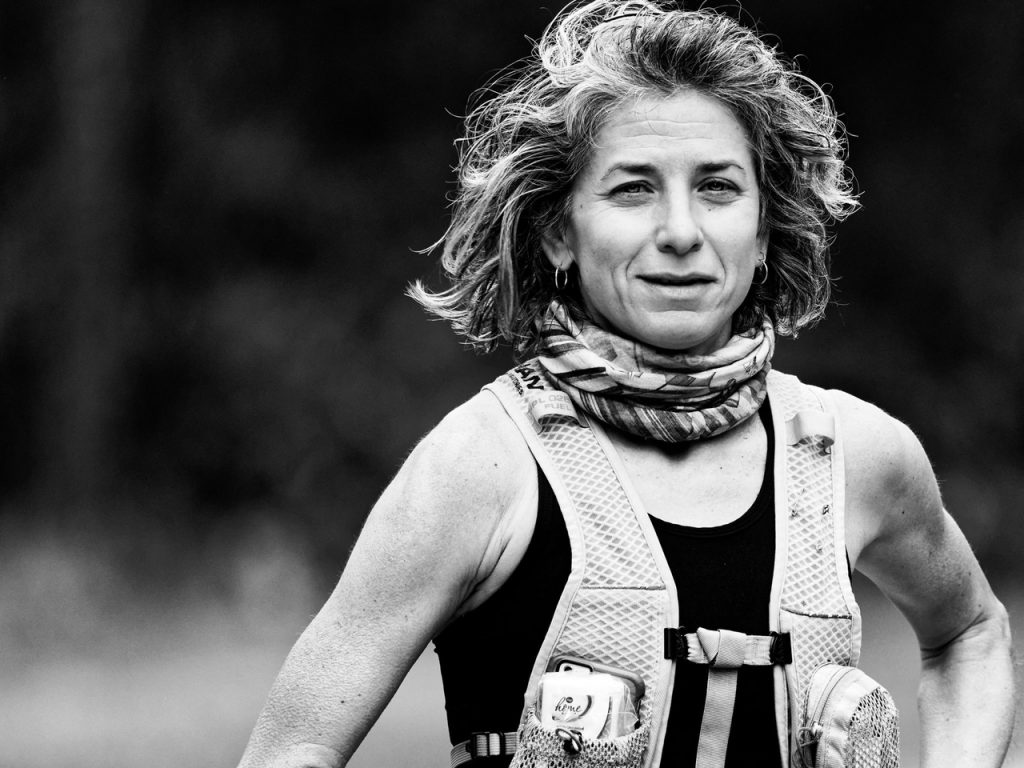
Running for happiness
She was miserable in her last year of college. She was working on an engineering degree, and at that time, women were not well accepted in the field. She wasn’t running at all. She was not in a good place, mentaly. She started thinking about the last time she felt happy and the first thing that came to her mind was running. That day, she decided to start over and ran a mile in the neighborhood she was living in.
When she resumed running she started with a mile, then a 5K, then a 10K until she finally got to her first marathon. A defining moment was a visit to a local bookstore. She found a black and white magazine called “Wild Trails.” She never imagined that trail running was even a thing. She saw a picture of a woman running a race called “Western States” and she decided that she was going to be that woman, a trail runner in Western States.
At the time she felt that trail running and her goal for Western States was love at first sight, but the truth is she put it aside for 10 years. She was at the end of her senior year of college, and she had to make an extreme effort because she had failed her first class and had to wait a whole year to retake it. This added an extra year to her time in college. She was focused on graduating and getting a job to support herself. But once she settled into a regular job, the idea of running once again came back to her.
It was in the early nineties, there was no internet. She found another magazine for runners, and in the very back was a small classified ad that read “ultramarathon.” She blindly signed up and entered a 50 mile race because it was close, and she began training. She ended up with appendicitis a few weeks before the race. She thought she could recover quickly and run another ultramarathon in a few months, but she had a setback and another surgery. So she laid off of running and focused on her work.
In 1991 she moved back to the town where she grew up in Tennessee, and by chance she joined a local running group. She joined the group for a New Year’s Day run. She casually mentioned that she was interested in ultramarathons. The people told her there was a guy who was part of the group who ran ultramarathons and that she should talk to him. They connected and became friends and training partners. He introduced her to other veteran ultramarathon runners. The group of them were all in the same town, and it was likely they were the only ultramarathon trail runners in the state of Tennessee at that time.

First ultramarathon
Her first ultramarathon was actually a road race called the Strolling Jim 40. It was close and running on the road was familiar to her. The race differed from the traditional marathon in that the course was marked with arrows painted on the road instead of volunteers giving directions. Aid stations were jugs of water stashed along the side of the road. She made her transition to the trails, eventually she got to do a 50K in Alabama, a very old and very technical trail. She fell in love with trails and decided that it was where she wanted to focus her efforts on.
Her first 100 was the Superior 100 in Minnesota. She thought it was perfect. The weather in September would be mild, and it was out of town so that none of her running friends would know if she had a DNF. She and her friends would run 30 miles together on the weekends, so she ran a “stealth” 40 mile training run to prepare for the race. She ran an extra 10 miles without telling anyone. She has since run 131 races of 100 miles each. It is her favorite distance, and is the one she plans to do for many years.
Susan got into life coaching because she didn’t like her first life experience with a DNF. She saw people going through the same thing and quitting the sport. She didn’t want to end up doing that because she really loved running ultramarathons.

Susan works to help her clients see that their thoughts don’t define them. Thoughts determine results, so questioning them is a method that can help you evaluate whether those thoughts are helping or hurting you. She is grateful that she started her running journey before social media. She wasn’t influenced by the “comparison trap” some runners fall into. She was able to approach ultra running with a sense of curiosity and a mindset to discover what she was capable of. She kept the mindset that it was fun and an adventure.
She keeps this sense of adventure, curiosity, and wonder as an approach to every race. Every race is a new experience for her, even if she’s done it before. The variables are always different:people, weather, race director, course, you and your physical condition, and that’s one of the things she likes most about it. The unknown can be scary for people, but she revels in the unknown because you don’t know what’s going to happen in the next mile.
Susan’s clients are usually people who are going to tackle a 100-miler for the first time, or someone who wants to move up in distance or is facing a big race or their dream race. But she also has clients who need life coaching like getting their family time back but also having some limits to still have time to run. And also anyone who is willing to change their mindset and work on it.
Connect with Susan
Leave a Reply