Author: Eric Deeter

  • The Mindset for Running Dangerously – Tom Foreman.

    The Mindset for Running Dangerously – Tom Foreman.

    Running again with a mindset to train for the distance.

    Tom Foreman is a correspondent for CNN, covering the news. He has been a journalist all his life, starting in high school and then a career working in radio and television. He has seen a lot of changes in journalism over the years. He appreciates the training he had in learning how to tell a story and make it informative.

    Tom wrote a book titled, My Year of Running Dangerously. The title came about because he went from being an average runner to being a distance runner in a short period of time. Tom ran marathons when he was in his 20s. He was competitive and place well in the races he entered, even though he hardly trained for them. But he stopped running as career and family obligations took more time and attention.

    Then his older daughter asked him to help her train for a marathon when she was in college. He started running again. And he went on to run 4 half marathons, 3 full marathons and his first 50 mile ultra, all in one year. 

    When Tom was young, as a natural runner, he barely trained for any races, but when he got older, in his fifties, he didn’t think he could fake his way through this time. So, for the first time ever, he trained for his races and found the training process to be fun. 

    He did some amazing things in order to promote his book, like running the Chicago marathon and then 2 weeks later he ran 5 marathons in 5 days, one of which was the Marine Corps Marathon. Two days after that, he ran the New York marathon and two weeks after that, he ran 50 miles. This led him to understand the appeal of running ultramarathons. For him the difference is that in ultra-distance running it’s more important to get into a kind of flow that feels like you can just go forever and appreciate the process of running rather than a time goal. That’s why when you have a bad moment in the race you have to have confidence in your training and keep moving until your head catches up and you can start fighting again.

    The fastest marathon of his life was when he was 52 years old. He said he could have been faster when he was younger, had he trained back then. Tom still feels competitive, but he says the race is about the distance, the day, and what he brings to it. There are races where he hasn’t finished very well, but he has been proud of the race. He believes that the older you get the idea is that you try to do well, not because it brings you individual honor or fame or attention, but because you become part of that rising tide that lifts all boats. You expand people’s imaginations about what humans can do. 

    He always tells people that he knows of no more welcoming community of athletes than the ultrarunners. “The longer the race the more welcoming people are. And I think that’s because you’re a smaller community.” 

    For him one of the secrets of all distance runners is learning that switch in your head that says I’ve gone as far as I can go. That switch is not right. It’s right for your comfort, but it’s not right for your ability. And people are surprised when he says that in his experience when you get to the point of saying “I don’t think I can go any further” that you’ve got probably about 20 miles left in the tank.

    Tom was running years ago, and he caught up with a 41 year old guy who was having a hard time.  Tom found him in the woods, and he helped him to start running with him again. This man said, ”I feel so bad about being the last one out here.” He convinced himself in his head that he had to be the last person on the course other than Tom. He wasn’t anywhere near last, it was only his imagination. This is an example of how our mindset can get confused about reality and sometimes cause us to give up.

    Some of the races Tom says he might consider is the Comrades Marathon, Dragon’s Back in Wales and even perhaps the Bigfoot 200 or Tahoe 200.
    The phrase that describes Tom’s philosophy of life is,’‘If it is inevitable it is ideal.” Whatever circumstance you find yourself in, whether it’s in your career or in your life, that’s the circumstance you have. Which makes it perfect.


    Instagram

    Book

  • Monday Mindset: Fear of Success.

    Monday Mindset: Fear of Success.

    The mindset to celebrate success.

    Speaking notes:

    There are some people out there who are afraid to feel good about success.

    These people are afraid to win. 

    And if they do win, they play it cool and act like it’s no big deal.

    Other people celebrate every time they win. Even the smallest wins they give a WHOHOO!

    Who do you suppose is going to have success in life?

    Some of you listening to this will be scratching your head and wondering, how can anyone be afraid of winning . . . success?

    If you Google “fear of success” you’ll get about 430 million results.

    There are a lot of us out in the world who struggle with the idea of winning and being successful.

    A lot of different reasons people develop fear of success.

    Mine came from growing up in church.

    Lessons I learned there:

    Blessed are the poor in spirit.

    Blessed are the meek.

    Put others before yourself.

    God will only give you money so you can support the church.

    Love of money is the root of evil.

    My takeaway: 

    Good Xans aren’t supposed to be competitive.

    Good Xans aren’t supposed to want a surplus of money.

    Good Xans aren’t supposed to be winners.

    Result:

    Second to bottom on my HS tennis team. Every game a tie.

    Rarely won at ping pong. Most games a tie.

    I never celebrated when I did win.

    Work with life coach to get over my limiting beliefs.

    One change I made was to celebrate my wins (achievements).

    Old me: Play it cool when I completed a goal. Check the box … next!

    Coach: If you don’t celebrate, your mind won’t realize that success is important.

    When you celebrate your wins, your mind remembers. The next time you are working on a goal or trying to win a game, your mind is a work pushing you forward.

    If you don’t celebrate your wins, your mind says, “Pfft! It doesn’t matter.”

    No matter who you are, you need to remember to celebrate when you reach your goal and when you come out a winner!

    Do the dance in the end zone. Jump up and down. Raise your hands in the air and yell. 

    Celebrating your success is just one of many tools you can use to live your best life.

    As a life coach, I help my clients find the most effective tools to reach their goals and avoid burnout.

    If you are a business owner or lawyer facing burnout and stress, I can help. Contact me for a free mindset reset call: Calendly

  • Tough Girl Challenge Mindset – Sarah Williams.

    Tough Girl Challenge Mindset – Sarah Williams.

     Inspiring women to have a mindset for adventure and challenge.

    Sarah Williams became a runner in order to save money on her commute to work. She had followed the typical path of getting an education and finding a career. She found herself short of money for the month and decided to run to work rather than take public transportation. She soon found that she enjoyed running.

    Some of her friends had signed up for the London Marathon, so she decided to join them. She wasn’t satisfied with completing just one marathon and decided to run a marathon every year until she turned 30. 

    Sarah had a corporate job but always felt that something was missing in her life and felt that she could never figure out why she wasn’t happy like the people around her in the company. She realized that her happiness wasn’t going to change on its own, if she didn’t change her environment. She was in a fortunate position because she had savings and just thought ”I can’t go on living my life like this” and made the decision to quit her job.

    She asked herself the questions ”what do I like, what don’t I like, what would I like for my life” and that’s when she started blogging which was a combination of her passions and when social media started to move forward she thought she could start a podcast and that’s when a friend of hers told her “why not talk about amazing women and that changed her life. She began to focus on motivating girls and women. She started the Tough Girl Podcast.

    She told herself that she couldn’t “talk the talk” if she didn’t “walk the walk” so she signed up for the Marathon des Salbes, a 251km (156 mi)  7-day race through the Sahara Dessert. She pumped up her training so much that she damaged her health and had to postpone her start for a year. She recovered and started training again at a more moderate pace. She completed the challenge and wrote about it in her blog and then in a book Tough Girl Sahara Challenge , that is both a memoir and a handbook for how to prepare for the Marathon des Salbes. 

    She loved the challenge, but felt that the adventure was over too quickly. So she decided to take on the Appalachian in 2017. She figured if she did the 2,000 miles in 100 days, averaging 22 miles per day, it would sound pretty enduring and challenging. 

    She That was her big Appalachian Trail hiking challenge but she ended up injuring her left knee. So her next challenge was cycling down the west coast of North America. She continued her adventures in hiking and is still pushing herself to keep going and find new adventures.

    She has always worked a lot on the mental side of things, on the power of visualization, imagining herself crossing the finish line, physically having that medal around her neck and always focusing on that being a choice, being there is a choice for her. She often checks in with herself to see how her body is feeling. She asks herself questions like: how do my feet feel, when was the last time I ate, do I need a sip of water, do I need electrolytes, and she goes through the things her body is asking her to do. She also has a spreadsheet where she can see how many miles she’s done, how many strength and conditioning sessions she has done and so she knows she’s ready. She reassures herself that she is strong and it’s just a case of getting out there and doing it.

    Another thing Sarah does is write down on a piece of paper, on the left side all the bad situations that could happen in a race and on the right side the things she can do if those things do happen. This helps her be prepared, and if it does happen she’s already worked all those things out in her head.

    Sarah wants to inspire girls believe in themselves. She believes it’s necessary to let young girls see women accomplishing big challenges like being in the Olympics. Too often women in sports get little media attention. Her podcast is a way to give positive role models for young women to see that they can go after big goals and a life of adventure.


    Connect with Sarah:

    https://www.toughgirlchallenges.com/

    Facebook

    Instagram

    Twitter

  • Can You Handle the Truth?

    Can You Handle the Truth?

    Speaker notes:

    It’s easier to fool people than it is to convince them they have been fooled.

    This quote has been attributed to Mark Twain. The irony is that there are no references showing Mark Twain saying these words. And yet the uninformed continue to credit him with this proverb.

    Mark Twain did write an essay called “What is Man?”

    He talks about how people tend to discover “truth” and then never question it again.

    They “know” they’re right and anyone who disagrees with them is an idiot (racist, bigot, homophobe).

    Star Trek: the Motion Picture

    V’ger returns looking for its creator.

    Doesn’t believe humans were capable.

    Crew of Enterprise finds confirmation code & sends it.

    V’ger burns out the data connection.

    Doesn’t want to see the proof.

    Same thing happened to Galileo in 1632.

    Published idea that the earth revolves around the sun.

    Catholic – Earth is the center of everything.

    Other astronomers who disagreed wouldn’t even look in the telescope.

    Galileo branded a heretic & sentenced to house arrest.

    You might think we’re different. Scientists now look at evidence and discover new truths about our world.

    Max Planck wrote this about how science works: Scientific progress doesn’t come from scientists being convinced by the evidence. The old scientists die out and the younger ones are more familiar with the new theories and adopt them.

    You and I do the same thing!

    There’s a psychological principle called “confirmation bias”. 

    We accept ideas that agree with what we believe to be true.

    We question ideas that disagree with what we believe to be true.

    The danger: you end up a prisoner in your own mind.

    You have a sense of security.

    But you can’t grow. You are stuck.

    You’ll be that old man or woman who tells the same stories over and over.

    How do you get unstuck?

    1. Find your anchor truth. 

    This is your stake in the ground . . . the thing you believe in your core.

    Not unquestioned belief or blind faith.

    But you’ve examined this truth and resolved your questions.

    My anchor truth is this: God created all there is in this universe. All power that is used by human or spiritual beings originates within God.

    1. Ask questions. 

    About what you think you know.

    About what you know for sure.

    About what you’ve been told.

    1. Question the “experts” – status and education.

    Remember that experts can be wrong (often they are).

    Look at other experts who disagree w/ yours.

    1. Consider opinions that challenge your truth.

    People who think differently may not be idiots (racist, bigot, homophobe).

    They have reasons they believe what they do.

    Even the Flat Earth Society has reasons for what they believe. 

    Ultramarthon mindset: durable, flexible, adaptable.

    Every race is different. There is no formula for success.

    Success comes from mind and body working together.

    If you get locked into “this is how it has to work”, you’ll fail.

    Ultramarathon mindset for business success: durable, flexible, and adaptable.

    That’s what I help my clients do.

  • A Mindset for a Series of Sprints: Dallas Amsden

    A Mindset for a Series of Sprints: Dallas Amsden

    Getting things done in short bursts

     Dallas played soccer and basketball as his usual sports in high school and never ran long distance races. When he decided to run track for a couple of years, his longest race was the 800. H says he had sprinter’s legs and sprinter’s body type so he never ran long distances, although he tried several times. 

    Ten years ago he signed up for a 10K race. On race day the temperature was 27 degrees, and he didn’t have the right gear. He hadn’t trained properly for a trail race. He only trained on paved running trails. He came in about 30 seconds before the time cap, and he was the second to last person. He realized that his mindset is not that of an ultramarathon runner. Even when life is a marathon, he chooses to run it in short sprints and then take the necessary rest. So it’s not that he doesn’t like to run, it’s just that his mindset for running is a different style. 

    He does crossfit and says he would rather run 400 meters or 800 meters and then do pull ups or burpees or something with a barbell or box jumps and then run some more and repeat than do a long distance run.

    His 10K trail race was the result of his practice of setting 90-day challenge goals for himself. He makes sure the goals he sets are true challenges, often things he’s never done before. Sometimes it can be a race, sometimes a crossfit competition. The lesson he learned from his 10K trail race is that it’s good to research the course so you can prepare for the conditions.

    Dallas says he’s never experienced the runner’s high. He heard about the legend and the reports made him eager to experience it. But, as many runners discover, a runner’s high is often elusive and many never experience it.

    Nine years ago Dallas was diagnosed with depression and severe anxiety disorder. His therapist told him something that he found amazing and that he shares with a lot of people, he said: ”Congratulations, you have a tremendous imagination. The problem is that your imagination is geared to the wrong outcomes.” He still works to keep his imagination headed in the right direction.

    Dallas says that the key to success is managing your energy and managing your mindset. He talks about lactic threshold training. When your body reaches the point of lactic acidosis, lactic acid builds up in your muscle fibers and literally floods the muscles. And an intriguing thing that can happen is that you can train your lactic threshold so that it can push beyond that.

    He remembers learning that interval running is a good way to burn calories, especially if you’re training to get your heart rate up. So he keeps going to a local gym a couple of days a week to do interval cardio training and it’s like warming up for a couple of minutes and increasing the speed every minute to strive for a 5 on a scale of 1 to 10.

    Dallas’ approach to life is to break hard things down into a series of smaller steps. He tells the story of John F. Kennedy when he said that at the end of the decade he was going to put a man on the moon. And for that they had to start preparing with small steps. Each Apollo mission had a particular mission to achieve the dream at the end of the decade. So he does a work backwards mentality, and it’s something he does with his coaching clients as well. They set a goal or a place they want to be in the future and they plan small objectives to achieve their goal. He asks himself, what do I have to do each quarter physically, spiritually, professionally to get there?

    Dallas believes that an important lesson to consider is that we are competing only with ourselves and we are trying to be better than we used to be before. When he is having a bad moment or bad thoughts he focuses on creating a new mental space. He asks himself where he can go in his memory and find a place where he can just stay focused on the imagination. He doesn’t let all the negative things that are in his own brain overwhelm him.

    Connect with Dallas:

    Instagram

    Twitter

    LinkedIn

    Be a star podcast guest

    http://podcastprochecklist.com

  • Monday Mindset: Independence Day.

    Monday Mindset: Independence Day.

    What does independence mean to you?

    Fourth of July – Independence Day

    “We’re not going to take it any more.”

    Remember when you were a teenager – looking forward to independence . . . being free to make your own choices.

    At some point you realize that independence = responsibility.

    You’re free. And you can succeed or fail. And it’s all on you.

    Today you’ll see posts and memes about freedom and independence. And it’s good to celebrate. Freedom is better than living under socialism or communism.

    Fire up the grill, crack open a beer, watch the fireworks.

    And take a minute to think about what freedom means to you.

    For me, it was the freedom to look at my life and decide I wanted something different, something more.

    And I saw that I’m responsible for what I get in life.

    I wasn’t happy with the way my life was going, so I made different choices and went a different direction.

    I broke free from my limiting beliefs. I changed my mindset. And now I’m doing more than I ever imagined possible.

    That is what I appreciate about freedom. My success and my happiness is up to me.

    My assignment is to help as many people as I can live free as well. If life isn’t working out the way you’d hoped, you can change.

  • Ultrarunning and Nutrition – Chase Hammond

    Ultrarunning and Nutrition – Chase Hammond

    Mindset and vision to go the distance

    Chase lives in Hays, Kansas, has lived there for about 20 years, worked at UPS for 14 years and went to college at Fort Hays State and graduated there with a degree in health and human performance. 5 years ago he and his wife decided to go back to school for nutrition, and she got her master’s degree at Hayes and psychology. Then they both finished getting their master’s degree in nutrition. So he quit working at UPS and they started the ultra-endruance-athlete supplement company Ultraverse.

    He was always interested in nutrition, and when he was in college he never thought he would be smart enough to pass biochemistry and all that goes into getting a master’s degree in nutrition. But Ultrarunning was what opened his mind to learn that we are much more capable than we think we are. When he did his first 50 mile, he was going for mile 40 and he was in an extreme amount of discomfort and he thought he could pass biochemistry because there is no amount of studying that is going to suck as much as this. So he put it all together and then within a couple of months he said to himself that he wanted to find the best online nutrition school he could and he was going to enroll.

    In high school Chase refused to run more than 200 meters ,but he was always a decent athlete in school. He liked soccer and weight lifting and just ran to stay in shape but never more than a mile. He decided on doing the Colorado 14ers (the mountains over 14K feet) because he enjoyed hiking. But after only doing one he got wiped out and thought he really liked doing that so to step it up he would first have to work on his cardio and getting in shape. A couple of weeks later he ran 2 miles and then just trying to increase his mileage it became an obsession with how far he was capable of going. At the time he had no idea ultrarunning existed so at that point he thought he was going to try to run a marathon. His previous max distance was 5K. 

    He then did a 10K and then a marathon program of his own in about 6 or 7 months, successfully finishing the the Colorado Marathon. He discovered ultramarathons when he saw someone wearing a shirt from a 100 mile trail race. He was impressed because his marathon left him hardly able to walk for several days. 

    He did some research and found out what it was all about, and then the next thing he did was sign up for the  World’t Toughest Mudder with the goal of doing 50 miles in the obstacle race.  Then little by little he decided that 100 miles would be an incredible goal for his life so he went through the 50K and then the 100 mile program which lasted 6 months each. It took him 3 years to get to the place he could run 100 miles. He thought it would be a life goal, but he realized what hard work could accomplish and how quickly you can achieve something that seemed unbelievable before.

    After a few years of racing, Chase and his wife, Casey, decided to become race directors.. When he first got into trail running it was at Wilson Lake, in central Kansas, and he says it’s very different than most of the trails in Kansas and it has incredible views. He tries to get in at least a couple of times a month to run there and he would always talk to his wife since they are also big campers they thought why not have a trail race right there. It’s such an awesome place it could be one of the best showcase races because of how beautiful the land is. So they were always talking about it and finally they said that they knew enough about the sport and they like to organize events so they could work together on something like that and it seemed like a really fun thing to do so they did it. Their goal was to organize a good race and they liked it so much that they decided they wanted to do more races because it was an incredible experience.

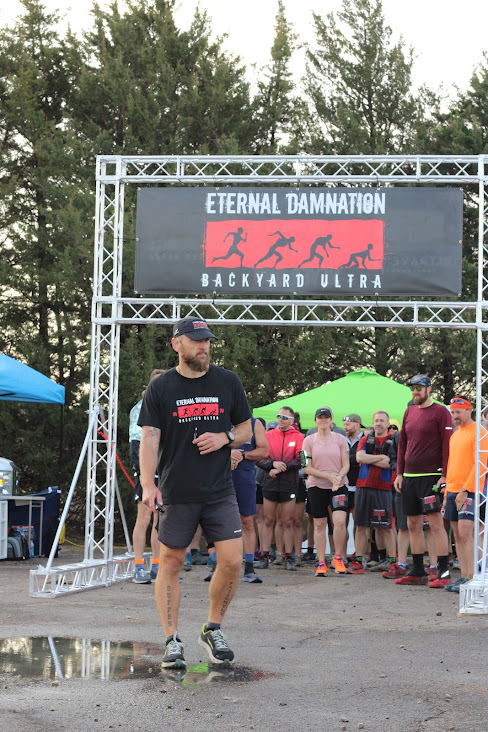
    The race they host is called Hell Creek which is a 20 mile and 100 mile race, and this year they also incorporated the 140 mile race called Pure Hell 140 mile. They also do a last-man-standing race called Eternal Damnation. And this year they created a new race called the Cowboy 200. It will be a point-to-point race on a rail trail in Nebraska. 

    Chase says that in the last man standing race a lot of people get carried away with the amount of rest they’re going to get between laps, and that he prefers to take it easy and have only 5 or 6 minutes of rest in the laps, just enough time for his crew to help him refill the water bottles. He says that the slow pace is better than an extended rest because the impact on your legs is going to build up. In this race it’s a little different because on every lap everyone has a chance to drop out. It’s not like a 100 mile race where I have to do 100 miles, otherwise you don’t reach your goal and you fail. In the last man standing there can only be one winner.

    Chase tells us that he always tells people who want to do 200 miles that they can do it if they’ve already done 100, that it won’t be any harder on your body because you’re moving at a much slower pace. It’s a lot of hiking energy, and there’s not as much impact. You’re better off moving at a slower pace, and it’s more of a mental game than a big physical effort. Lack of sleep is a major issue that must be dealt with. Chase in the Moab 240 finished in 96 hours and slept 6 hours so it was about 6 hours of sleep in 4 days. He started having auditory hallucinations. He heard people whispering to him and he knew he was alone there and that’s how he knew he had to sleep.

    He just finished an attempt at the Cocodona 250, and it is an extreme race. The terrain is much more difficult than the Moab, in his opinion. It has a lot more elevation and one section was just rocks on rocks, and he was really beat up after that section. The heat of the day and not having slept made him start having hallucinations and he felt terrible. He says that led him to make some terrible decisions. He decided he needed sleep, but he only had a few sips of water before he went to bed so he hadn’t rehydrated his body all day. After that he started again and he was only good for about a mile and he started to get confused again because of dehydration. He got sick to his stomach, and he was just walking from tree to tree. He was lying under a tree, and he says what he should have done is turn around and go back to his team to sleep and rehydrate. But his 96-hour goal was still on his mind and he wanted to keep going but he couldn’t, and he laid down under a tree. He called his crew and they were able to find him. The trail he was on wasn’t far from the road. They realized he probably had internal bleeding from severe dehydration. So they went to the emergency room and he was diagnosed with heat stroke and severe dehydration.

    When he was in school to get his masters in nutrition, originally his wife and he had talked about opening an online nutrition consulting business focused on athletes but he also wanted to primarily transition on an individual basis. So that was the plan until almost the last Semester of his school and he started looking into the different supplements and things that he was taking as he wanted to learn about them and he found that most of the supplements out there are very mis-dosed for the most part. They really don’t conform to what the scientific literature says so he started putting together his own formulas and he told his wife that he should try that because it will be fun and it could potentially lead to something where they could live their dream and have a business they could do from anywhere..

    When you go to a race you base your diet on a liquid diet with water and electrolytes. But he knows that there are people who travel and depend on seasonal food and his advice is to imagine what food you are going to find at the aid stations so that you can integrate it into your training diet before the race.

    Connect with Chase:

    Facebook

    Website

  • Monday Mindset: Sunk Costs

    Monday Mindset: Sunk Costs

    Speaker notes

    The worst movie my wife and I ever saw was Seven Six-Gunners.

    Rented VCR. My wife likes westerns. The summary sounded interesting.

    Bad acting (bartender – hippie off the streets reading lines from cue cards). Plot was lost in the sagebrush. Camera work and sets looked like a class project from 1st year film student. End was like almost sneezing.

    Ten minutes in, we commented on how bad it was. We watched the entire 90 minutes.

    Why?

    Sunk costs

    Sunk costs is the feeling that you need to keep going because you’ve already invested time and/or money and made a decision.

    Here’s another way it shows up:

    We went to a Mexican restaurant. I ordered a burrito. Picture made it look small – ordered a side of refried beans.

    Burrito was huge.

    I ate all of it and half the beans – because I’d paid for it.

    Another example:

    You’re in a job that you used to love. But now you’re just going through the motions. You get an offer for a job that will give you the chance to develop new skills. But you’ve spent the last 12 years working your way up. Career plateau – but sunk costs will keep you stuck.

    Sunk costs – will keep you stuck in bad relationships, bad job, house, neighborhood you really should move away from.

    In business or investments – throw good money after bad.

    You think that if you keep going and keep trying that you’ll recoup your investment.

    Gamblers have the same motivation. Keep playing and I’ll get it all back.

    How do you keep from getting sucked into the sunk-cost vortex?

    Coach’s question: “How’s that working out for you?”

    Is what I’m doing getting me the results I want?

    1. Step back and imagine what you’d say to someone in exact same position.
    2. Look at cost of opportunities you’ll miss.
    3. Reconcile sunk costs as lost.

    Let the past be past. Let it go and decide what kind of future you want for yourself.

    If life isn’t working out the way you want, change your mindset and make it work for you.